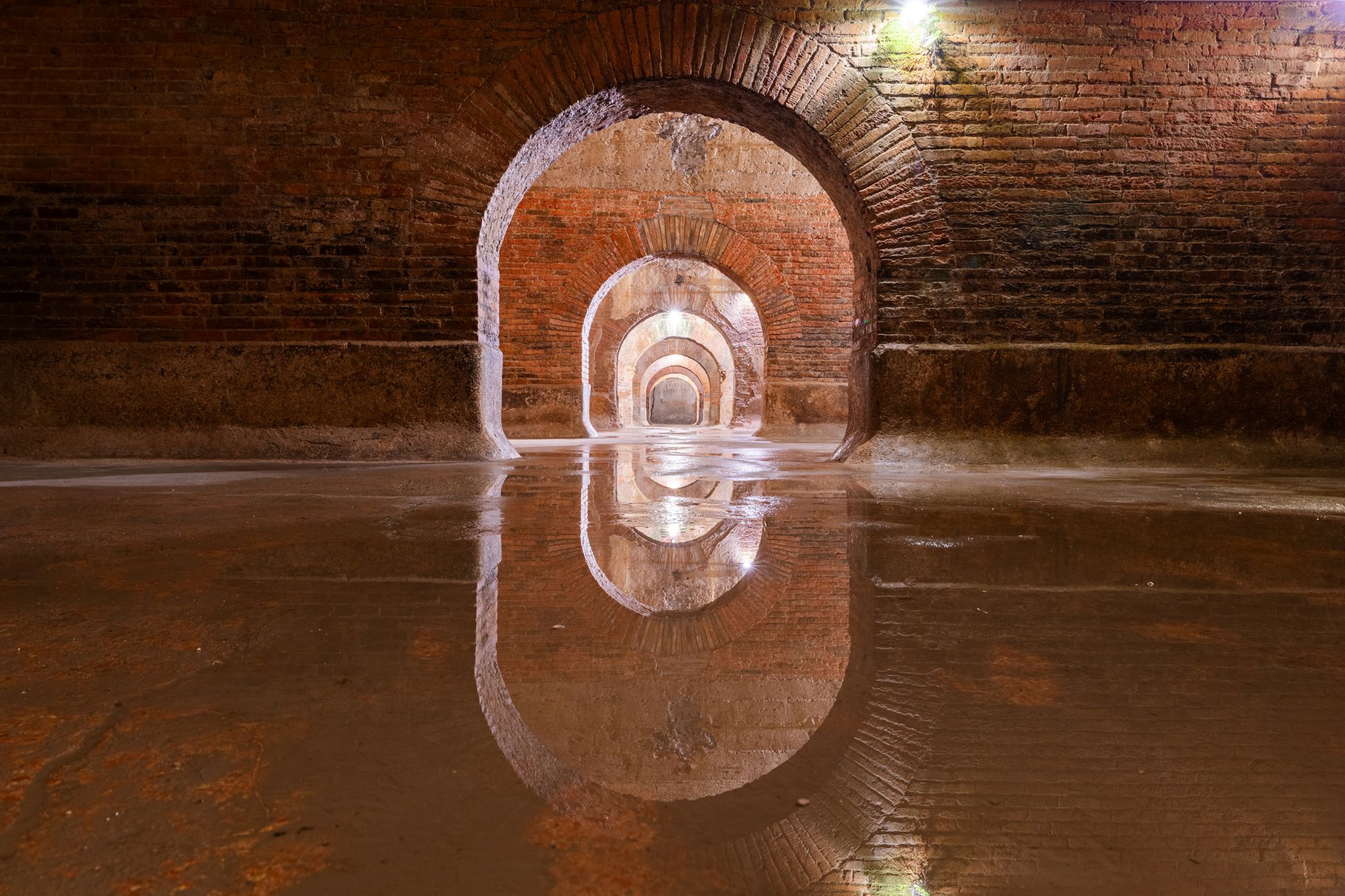
Among the oldest and largest in the world, the Roman Cisterns of Fermo were built between the 1st century BC and the 1st century AD. The 30 rooms that make them up, of equal size vaulted, extend over an area of 2,200 square meters. Ancient cisterns for collecting water to serve the city, they were abandoned and forgotten until their partial reuse from the late 1800s, and for about a century, as a municipal aqueduct.
The history of the Roman Cisterns
In a neighborhood of Fermo of extraordinary beauty runs Via degli Aceti, with its characteristic brick paving, where solemn-looking buildings alternate.
Walking along this street, one encounters the old late medieval entrance (now at Via Paccarone, 36) to the great Roman cisterns.
It was almost certainly decided to create what are commonly called purification or liming pools to meet a water demand that could not otherwise be fulfilled. The large underground complex dates back to the end of the 1st century BC and is unique in Italy for its size (about 2200 square meters).
The underground rainwater reception and drainage system, similar to the water apparatus of Chieti, allowed for efficient redistribution to various areas of the city. Three reservoirs were built for storage and subsequent supply, located on Girfalco, in the current Largo Temistocle Calzecchi Onesti, and on Via degli Aceti, which of course were at different heights.
The reservoirs of the Roman Cisterns
The first reservoir is currently not accessible, as it is completely buried. However, excavations in 1927 revealed four non-communicating brick chambers, vaulted and very similar to the large cisterns.
The second is known as the Small Cisterns because its capacity is smaller than that of the reservoir located on Via degli Aceti, which does not exhibit significant structural discrepancies compared to the smaller one.
The Large Cisterns extend across a fairly wide area that includes Via Paccarone, Via di Vicolo Chiuso, Via degli Aceti, Largo Maranesi and has a maximum capacity of about 15,000 cubic meters. The interior consists of thirty chambers arranged in three rows, each having walls lined with opus signinum or cocciopesto, which, as Vitruvius wrote, was mainly used in the construction of cisterns, aqueducts, and thermal baths because it is suitable for the waterproofing of lime mortar.
Visiting the Roman Cisterns of Fermo is incredibly thrilling, as they are in perfect conservation state and vividly convey the grandeur of such an efficient project that some chambers were used until the 1980s.
It is very evocative to come across outdated writings such as ‘Calm, exit’, dating back to World War II, when the spaces were used as shelters against bombings.